
## Mini basket to go here ##
Gold Cross Necklaces and Crucifixes
What’s On This Page
- Our Gold Cross Collection
- 9ct, 18ct or 22ct? Choosing Your Carat
- Yellow, White or Rose Gold
- Gold Crosses for Men
- Gold Crosses for Women and Everyday Wear
- Hallmarks: How to Know It’s Genuine
- Caring for Your Gold Cross
- Gold Crosses as Gifts
- Frequently Asked Questions
- Visit Us
Our Gold Cross Collection
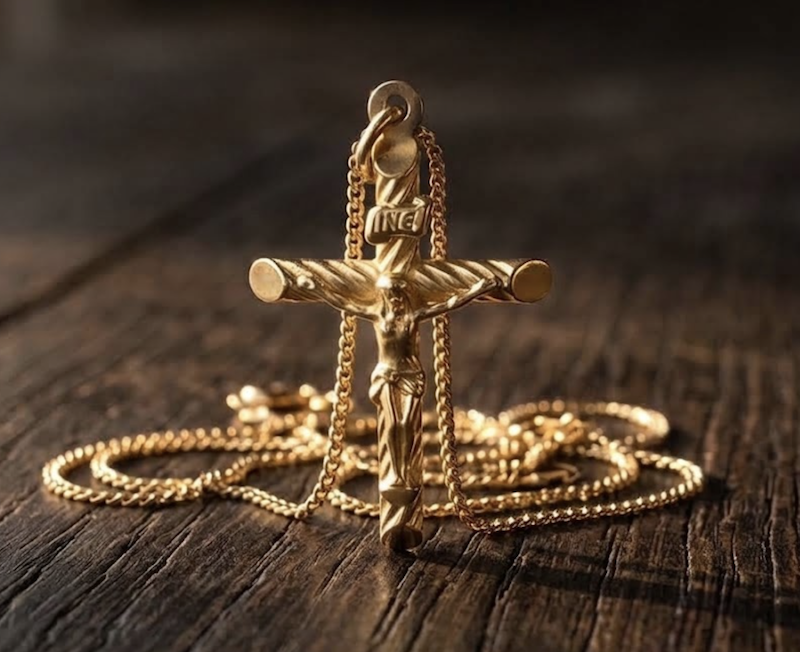
A gold cross necklace is one of those pieces that never really goes out of fashion. Whether you’re after a gold crucifix pendant with real weight behind it, a plain gold cross for everyday wear, or something to mark a christening, confirmation or milestone birthday, it’s one of the most asked-for pieces in our Blyth shop — and has been for as long as we’ve been trading.
At Northumberland Goldsmiths we carry a wide range of gold crosses and crucifixes in 9ct, 18ct and 22ct gold, in yellow, white and rose finishes. Some are simple and understated — a small cross on a fine chain, worn every day and barely noticed until the light catches it. Others are chunky, deliberate statement pieces, built to be seen. Every single one is hallmarked. We don’t sell gold plate or gold filled dressed up as solid gold, and we never will.
This page covers our full gold cross and crucifix range — for men, for women, and for anyone who just wants a good, honest piece of gold jewellery with meaning behind it. If you’re specifically after a heavier, more traditionally masculine piece, our gold crosses for men collection goes into more detail on those styles, chain weights and finishes. If sterling silver suits your budget or your everyday style better, have a browse of our silver cross necklaces instead — equally well made, just a different metal.
Every gold cross and chain we sell can be bought as a set or as separate pieces. If you’ve already got a chain at home and just need a new pendant, or you want the pendant now and the chain further down the line, that’s no bother at all — pop in and we’ll sort it.
9ct, 18ct or 22ct? Choosing Your Carat
The carat of a piece of gold tells you how much pure gold is in the alloy — the rest is other metals, mixed in deliberately to add strength, alter colour, and change how the piece wears over time. It’s usually the first question we ask when someone comes in looking for a 9ct gold cross pendant, or when someone’s not sure what the difference actually is.
In the UK, gold jewellery is marked by its millesimal fineness — the number of parts per thousand that are pure gold. 9ct gold is marked 375 (37.5% pure gold), 18ct is marked 750 (75% pure gold), and 22ct is marked 916 (91.6% pure gold). Higher carat means more pure gold, a richer colour, and — because pure gold itself is a soft metal — generally a softer piece that needs a little more care.
| Carat | Durability | Colour Depth | Typical Investment Level | Best For |
|---|---|---|---|---|
| 9ct gold (375) | Most hardwearing — more alloy content makes it resistant to knocks and daily wear | Paler, more muted yellow tone | Entry-level — the accessible way into solid gold jewellery | Everyday crosses, first gold pieces, larger or chunkier designs where weight and durability matter |
| 18ct gold (750) | Good balance of strength and softness — holds detail well without being fragile | Rich, warm yellow — the classic “gold” colour most people picture | Mid-range — the traditional choice for a lasting piece | Pendants and crosses worn regularly where colour and quality matter as much as price |
| 22ct gold (916) | Softer and more prone to surface marking — needs gentler handling | Deep, intense yellow — the richest gold colour available | Premium — maximum gold content, closest to investment-grade | Traditional and religious pieces, collectors, and anyone who wants the purest gold colour on show |
There’s no wrong answer — it comes down to how you’ll wear it. If it’s going on every day, under a jumper, in and out of the shower, 9ct is sensible and it’s still solid, hallmarked gold. If it’s a special piece for occasions, or you want that deeper, richer colour, 18ct or 22ct will give you that. Pop in and we’ll talk you through what suits your budget and how you’ll actually wear the piece — that’s more useful than any chart.
Yellow, White or Rose Gold
Carat tells you the purity — colour is a separate choice entirely, and it comes down to which other metals are alloyed in.
- Yellow gold — the traditional choice, and still the most popular for a gold cross and chain. The alloy metals (usually silver and copper) are balanced to keep that classic warm gold tone.
- White gold — alloyed with metals like palladium or silver and typically finished with a rhodium plating, giving a bright, silvery-white shine. A popular modern alternative for anyone who prefers the look of silver but wants the weight and value of gold underneath.
- Rose gold — a higher proportion of copper in the alloy gives it that distinctive warm pink tone. Increasingly popular, particularly for women’s pendants and layered necklace styles.
All three are equally “real” gold at the same carat — the colour is simply the alloy recipe. It’s entirely down to taste, skin tone and what you already wear day-to-day.
Gold Crosses for Men
Men’s gold cross necklaces are one of our steadiest sellers, and for good reason — a solid gold cross and chain is one of the few pieces of men’s jewellery that works for absolutely any occasion, from a wedding to a night out. Popular choices include heavier crucifix pendants with real presence, plain contemporary crosses without religious imagery for a cleaner look, and traditional detailed crucifixes for those who want the figure of Christ represented properly.
Most men’s gold crosses sit best on a curb or belcher chain, usually in the 20-24 inch range, with the chain weight matched to the pendant so it hangs properly and doesn’t strain the clasp. For the full range of gendered styles, weights and chain pairings, head over to our dedicated gold crosses for men collection.
Gold Crosses for Women and Everyday Wear
For women, and for anyone who wants something a little finer, the range runs from tiny, delicate crosses on a light trace chain right through to statement pendants with detailing or a gemstone accent. Popular choices include a small gold cross worn close to the collarbone, layering pieces designed to be worn alongside other necklaces, and rose gold crosses for a softer, warmer look.
Chain length makes a real difference to how a pendant sits — generally 16-18 inches for a piece worn high and close, 20 inches and above for something that sits lower. As with the men’s range, it’s genuinely easier to decide in person, so pop in whenever suits and try a few against your skin tone before you commit.
Hallmarks: How to Know It’s Genuine
UK hallmarking law means any gold item over 1 gram sold as gold has to carry an official hallmark — applied by one of the UK’s assay offices, not by the jeweller or the manufacturer. It’s the only legal guarantee of what you’re actually buying, and it’s worth knowing what to look for, whether you’re buying from us or anywhere else.
- Sponsor’s mark — the initials of the maker or sponsor responsible for the piece.
- Fineness mark (carat mark) — the millesimal number stamped inside a shield outline: 375 for 9ct, 750 for 18ct, 916 for 22ct. This is the mark that tells you exactly how much pure gold is in the piece.
- Assay office mark — shows which of the UK’s assay offices tested and marked the piece: an anchor for Birmingham, a leopard’s head for London, a castle for Edinburgh, or a rose for Sheffield.
- Traditional standard mark — an optional but common additional mark. For gold this is a crown symbol. Worth knowing: the crown is the gold mark, not the lion passant — the walking lion is the sterling silver standard mark, and we still get asked to explain that mix-up fairly regularly.
- Date letter — an optional letter showing the year of hallmarking, still applied by most assay offices even though it’s no longer a legal requirement.
If a piece of “gold” jewellery has no hallmark at all, be cautious — it may be gold plated or gold filled rather than solid gold, particularly with pieces bought online from overseas sellers. Every gold cross and crucifix we sell is properly hallmarked, and we’re always happy to show you exactly where to find the marks and what they mean.
Caring for Your Gold Cross
Gold doesn’t tarnish the way sterling silver does, but it isn’t entirely maintenance-free. Lower-carat gold like 9ct has a higher proportion of alloy metals, so it can pick up a slight dulling over time, especially with regular contact with perfume, hand cream, and everyday grime. A soft polishing cloth and a warm soapy water clean (dry thoroughly afterwards) keeps most pieces looking sharp.
A few things worth avoiding: chlorine (so take it off for the pool or a hot tub), household bleach and cleaning chemicals, and rough handling of anything with fine detailing or a soft 22ct finish. If a piece needs more than a home clean — a proper polish, a re-tip on a claw, or a clasp repair — pop it into our Blyth workshop and we’ll sort it.
Gold Crosses as Gifts
Gold crosses and crucifixes are one of the most popular gifts we sell, and the reasons rarely change:
- Christenings and baptisms — a classic gift the child grows into and keeps for life
- Confirmations and first communions — a meaningful religious milestone across many denominations
- Milestone birthdays — particularly 18th and 21st gifts, where a solid gold piece feels like a proper step up
- Christmas and Easter — seasonal gifts with obvious religious significance
- Remembrance — a cross worn in memory of someone, often chosen to match a piece they wore themselves
Every gold cross from Northumberland Goldsmiths is presented in a proper gift box, ready to give. If you’ve got a specific date it needs to be ready for, give us a ring and we’ll make sure it’s sorted in time.
Frequently Asked Questions
Should I choose 9ct, 18ct or 22ct gold for a cross pendant?
It depends how you’ll wear it. 9ct is the most hardwearing and the most accessible way into solid gold — a sensible choice for a piece worn every day. 18ct gives a richer colour and is still robust enough for regular wear. 22ct has the deepest, most traditional gold colour but is softer and suits pieces that get a little more careful handling. None of them is “better” — it’s about how the piece fits your life. Pop in and we’ll help you weigh it up.
Will a gold cross tarnish or discolour over time?
Solid gold doesn’t tarnish the way silver does, but lower-carat gold can dull slightly with regular contact with perfume, lotion and everyday wear. A soft cloth polish and an occasional warm soapy water clean keeps it looking its best. If it ever needs more than that, bring it in and we’ll give it a proper polish.
How do I know my gold cross is genuine and not plated?
Check for the UK hallmark — a set of small stamps usually found on the clasp, the back of the pendant, or a tag. You’re looking for the fineness mark (375, 750 or 916), the assay office mark, and the sponsor’s mark. If there’s no hallmark, be cautious about what you’re actually buying. Every piece we sell is properly hallmarked, and we’ll happily show you where to find the marks in store.
Can you resize or replace the chain on a gold cross and chain set?
Yes — chain length and weight can usually be adjusted, and if you’d prefer a different chain style altogether (curb, belcher, trace, rope) we can match one to your pendant. Pop in with the pendant and we’ll talk through the options.
Can a gold cross or crucifix be engraved?
Most flat-backed crosses and crucifixes can take an engraving — initials, a date, or a short message. It’s a popular option for christening and confirmation gifts especially. Bring the piece in, or choose one from our range, and we’ll talk you through what’s possible on that particular design.
What’s the difference between a cross and a crucifix?
A plain cross is exactly that — no figure, just the cross shape, and it suits anyone whether the meaning is religious or simply aesthetic. A crucifix specifically includes the figure of Christ and carries deeper religious significance for many wearers, particularly within the Catholic tradition. We stock both, in every carat and finish.
Do you sell gold crosses specifically for men?
Yes — our gold crosses for men collection covers heavier, more traditionally masculine styles and chain pairings in more detail. This page covers our full gold cross and crucifix range across styles, carats and colours for everyone.
Can I buy a gold cross online and collect it in store?
Yes. Browse the collection online, place your order, and choose in-store collection at checkout. We’ll have it ready and waiting for you at our Blyth shop — no need to wait in for a delivery.
Visit Us
Photos only tell you so much with gold — the colour, the weight, how it catches the light and sits against your skin is something you really need to see in person. Pop in — no appointment needed — and we’ll bring out the full range across 9ct, 18ct and 22ct, in yellow, white and rose gold, and help you find the right piece and the right chain to go with it.
If you’d rather have a chat first, give us a ring on 01670 333 036 and we’ll answer any questions before you make the trip.
Northumberland Goldsmiths
3-5 Bowes Street, Blyth, Northumberland, NE24 1BD
Tel: 01670 333 036
Open Monday-Friday 9:30-5:00, Saturday 9:30-4:00

Sign up for our latest news & offers
Subscribe to receive updates, access to exclusive deals, and more.